In short
- Understanding a word once isn't the same as remembering it. Without a second encounter, most new words fade within days.
- What makes a word stick is being asked to recall it, a few times, at growing intervals.
- Keep your own words: the ones you actually needed are the ones worth learning.
- A few minutes a day beats an hour on Sunday.
In this guide
Why the words you look up don't stay
When you look up a word, you get the meaning at exactly the moment you need it, and that feels like learning. But your brain treats a single encounter as temporary. In the 1880s, the psychologist Hermann Ebbinghaus measured how quickly people forget new material, and found that most of it goes within the first days unless it comes up again.
Illustrative curve, based on Ebbinghaus's forgetting curve.
The good news is in the same research: every time you successfully recall something, it fades more slowly afterwards. So the goal isn't to look a word up harder. It's to meet it again, at the right moments.
Why the list in your Notes app doesn't work
Most people who live abroad, or use another language every day, end up with a list: words saved in the Notes app, screenshots, a notebook. It feels productive, but a list only works if you reread it, and almost nobody does. Even rereading isn't enough. Seeing the answer again feels familiar, and familiarity is easy to mistake for knowing.
Rereading tells you that you've seen a word before. Being asked for it tells you whether you know it.
A routine that actually works
- 1
Save the word the moment you meet it
The best words to learn are the ones life hands you: the expression a colleague used, the word on a sign, the one you couldn't find mid-sentence. Save it straight away, with an example, while you still remember where it came from.
- 2
Keep the example, not just the translation
"Vénère" means "angry", but you only really get it from "il est vénère depuis ce matin". A real sentence shows you the register and the words it usually goes with.
- 3
Get asked for it, don't just reread it
Cover the answer, fill in the blank, type the word from its meaning. Recalling is harder than recognising, and that effort is exactly what makes it stick.
- 4
Space it out: 1, 2, 4, 7 days
Come back to each word after a day, then two, then four, then a week. If you get it wrong, see it again at the same interval rather than starting over.
- 5
Stop when it's learned
Once you remember a word after a full week without seeing it, it's yours. Move on, and spend your time on the words you don't know yet.
Five minutes a day beats an hour on Sunday
Spacing only works if the reviews happen on the right day. A short daily habit, while the kettle boils or on the bus, fits that much better than a long weekly session, and it's easier to keep. If something can remind you which words are due, even better.
Which words are worth it?
Prioritise words you've looked up twice, words you hear around you, and set phrases ("en avoir marre", "at the end of the day"). A word you met once in a novel can wait.
Doing it without the admin
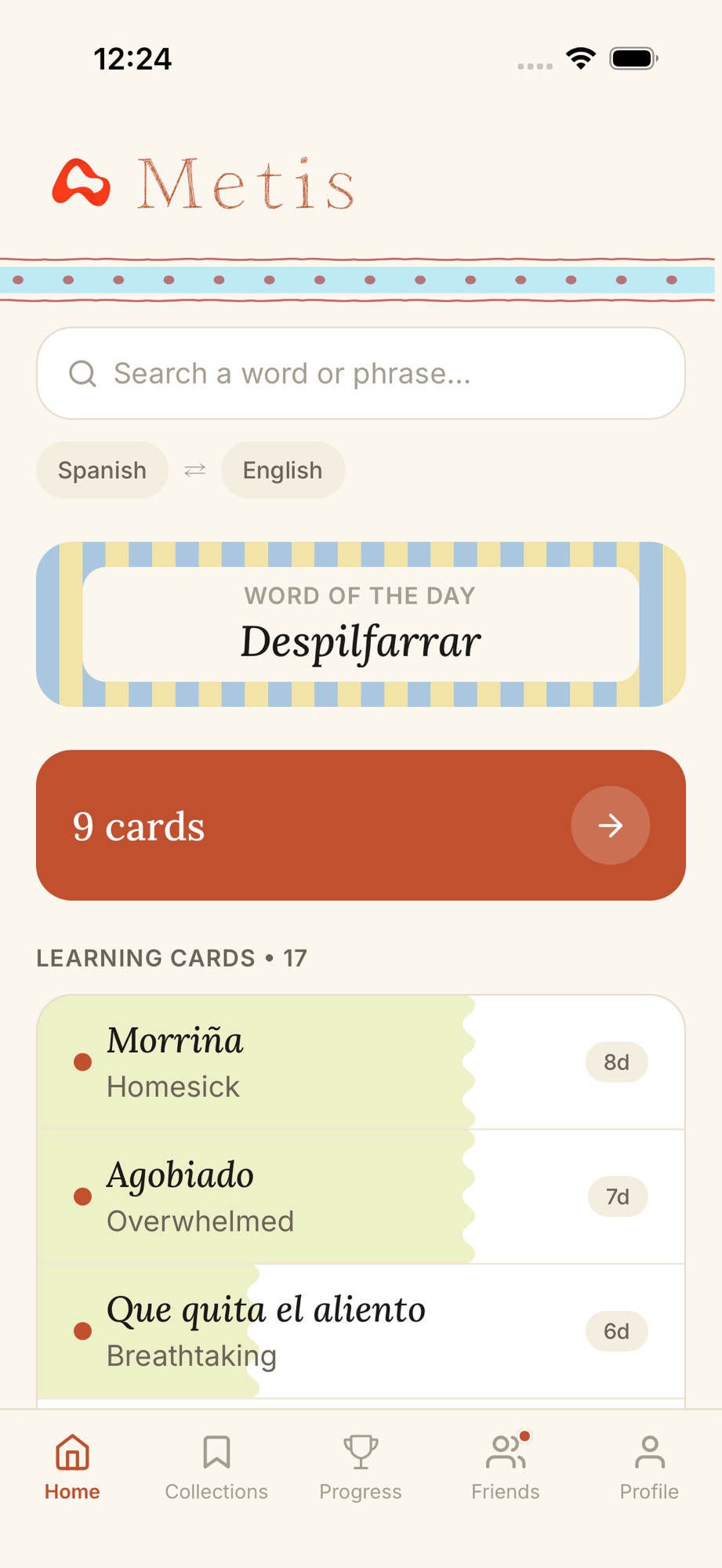
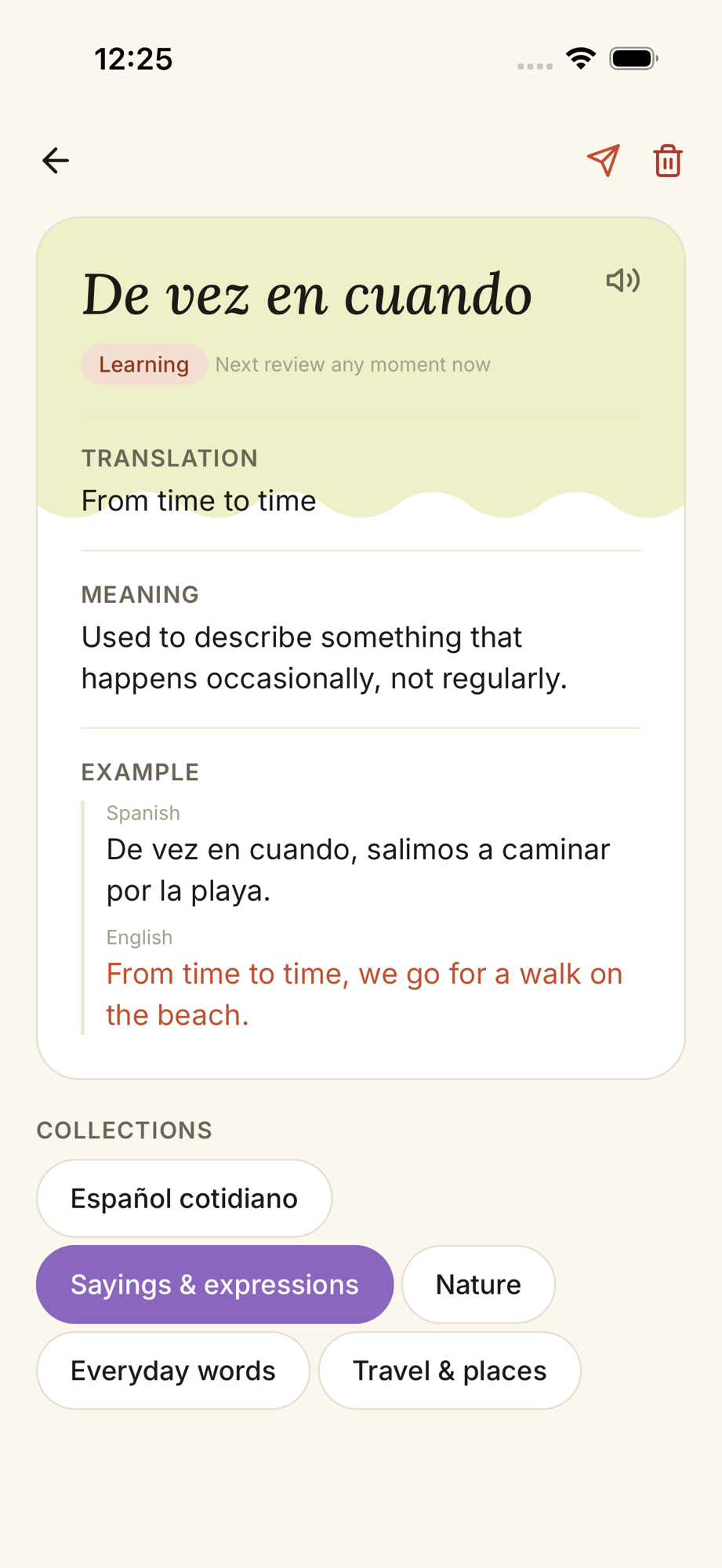
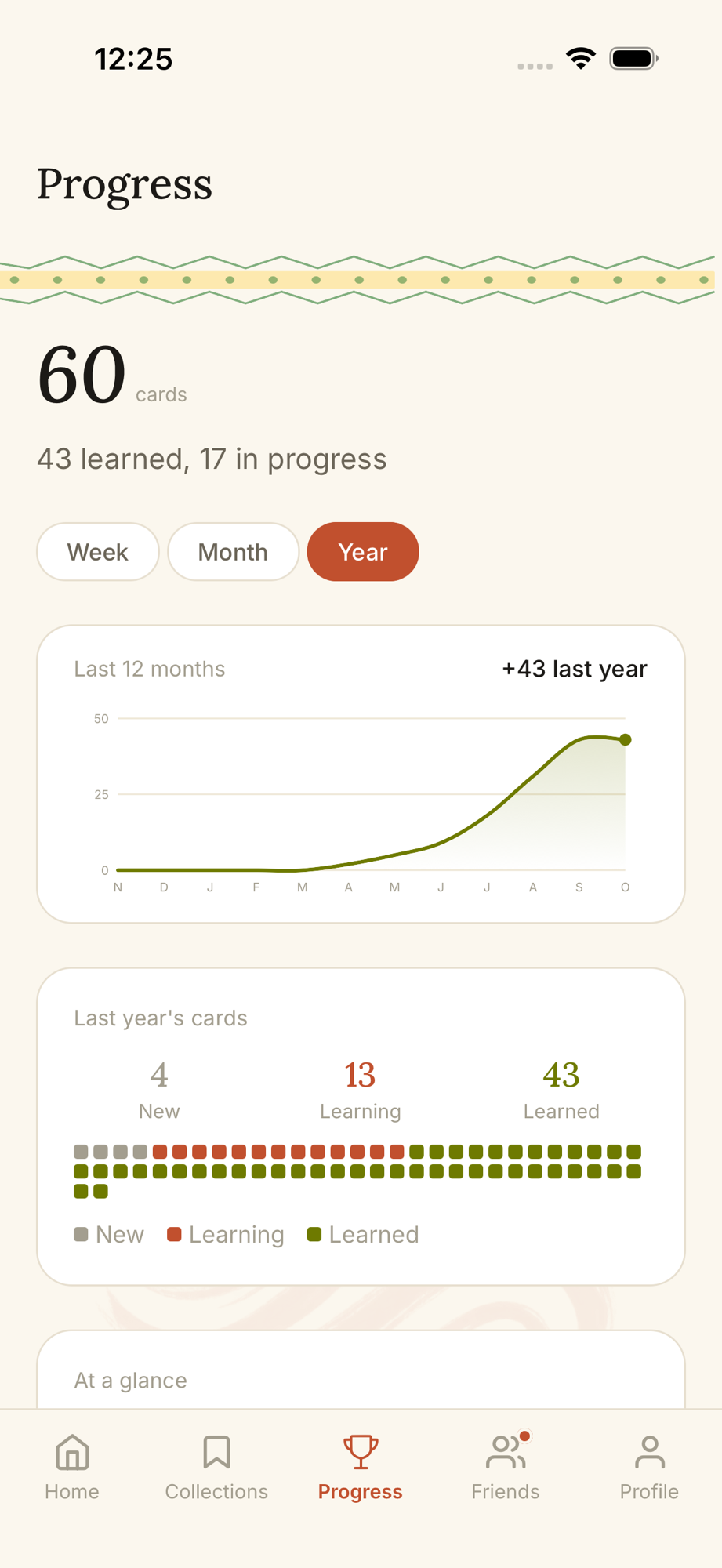
You can run this routine on paper, but keeping track of which word is due on which day is the part people drop. That's the job Metis was built for: you look a word up like you would in a translator, save it in one tap with its meaning and an example, and it comes back as a short quiz after 1, 2, 4 and 7 days until it's learned.
Questions people ask
How many new words can I learn a day?
Fewer than you'd think, and that's fine. Five to ten genuinely useful words a day, reviewed properly, adds up to thousands a year. Twenty words you never see again add up to nothing.
Is spaced repetition better than reading a lot?
They do different jobs. Reading and listening give you new words in context; spaced repetition makes sure the ones you care about stay. The two work best together.
What if I get a word wrong?
Getting it wrong is useful: it shows you which words need more time. See it again after the same interval instead of starting from scratch.
Do I need an app for this?
No, a notebook with dates works. An app just does the scheduling and quizzing for you, which is the part most people stop doing.